
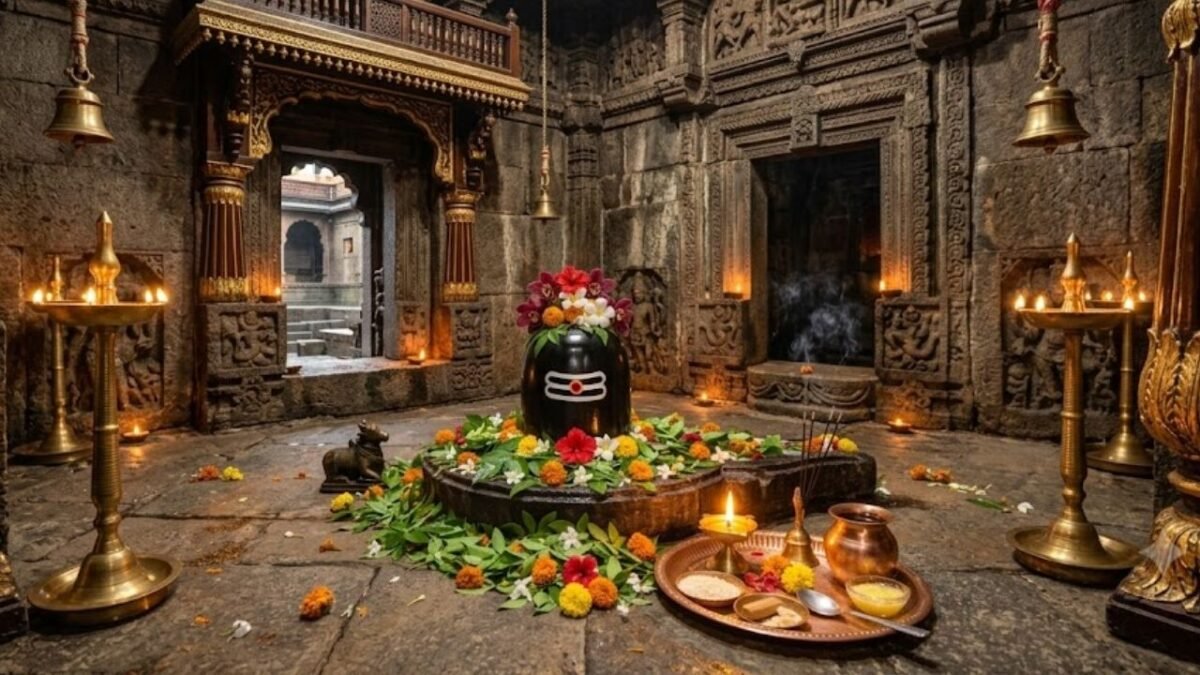

Summary: The 12 Jyotirlingas are twelve Shiva shrines spread across India, namely Somnath (Gujarat), Mallikarjuna (Andhra Pradesh), Mahakaleshwar and Omkareshwar (Madhya Pradesh), Kedarnath (Uttarakhand), Bhimashankar, Trimbakeshwar and Grishneshwar (Maharashtra), Vaidyanath (claimed by both Jharkhand and Maharashtra), Nageshwar (claimed by Gujarat, Maharashtra and Uttarakhand), Kashi Vishwanath (Uttar Pradesh), and Rameshwaram (Tamil Nadu). These are believed to be places where Shiva appeared as a jyotirlinga, a “column of light.”
Table of Contents
Introduction
If you ever stand at Mahakaleshwar in Ujjain a little before sunrise, you will hear a very particular sound. Temple bells ringing, priests chanting in low voices, and under all of it, the shuffle of thousands of bare feet on cold stone floor. People gather here every morning for the Bhasma Aarti, when the linga is bathed in sacred ash before daybreak. This ritual is not done anywhere else among the twelve Jyotirlingas. Stand in that crowd for even ten minutes and you start to understand something that most articles miss. The Jyotirlinga shrines are not just old temples. They are a living trail of faith that people in India have walked, rebuilt, protected, and kept coming back to for over a thousand years.
In this guide, we will go through what is actually known about each of the 12 Jyotirlingas, their locations, their recorded history, the stories behind them, and also the points where even scholars and pilgrim communities do not fully agree. Wherever the historical record is thin or disputed, we will say so plainly, instead of presenting old belief as proven fact.
What Is a Jyotirlinga?
A Jyotirlinga (from the Sanskrit words jyoti, meaning light, and linga, a symbol of Shiva) is a shrine where Shiva is believed to have appeared as an endless pillar of light. This story comes from the Shiva Purana, an important Shaiva text put together over several centuries in medieval times. According to the story, Brahma and Vishnu once argued over who was greater between them, and Shiva appeared as a pillar of fire with no beginning and no end, to show that both of them fell short of understanding his true nature. The twelve sites are believed to be the places where this light “settled” and is now worshipped in the form of a linga.
It helps to keep two things separate here. The meaning behind a Jyotirlinga, that it shows Shiva’s formless and infinite nature taking a visible shape, is a matter of faith and scripture. It is not something history can prove or disprove. The temples themselves, on the other hand, are real buildings with foundations, inscriptions, and a documented history of being built, destroyed, and rebuilt over the centuries. This article keeps these two things apart.
The standard list of twelve comes from the Shiva Purana and is also recited in the Dwadasha Jyotirlinga Stotram (“Hymn of the Twelve Jyotirlingas”), a Sanskrit verse that popular tradition attributes to the 8th-century philosopher Adi Shankaracharya. It is worth mentioning that, like many texts linked to Shankaracharya in popular memory, this is a traditional belief and not something confirmed through manuscript research. We are pointing this out simply because it shapes how millions of devotees see the list, not because we doubt its importance to them.
The 12 Jyotirlingas: Complete List
| No | Jyotirlinga | Location | State |
|---|---|---|---|
| 1 | Somnath | Prabhas Patan, near Veraval | Gujarat |
| 2 | Mallikarjuna | Srisailam | Andhra Pradesh |
| 3 | Mahakaleshwar | Ujjain | Madhya Pradesh |
| 4 | Omkareshwar | Mandhata Island, Narmada river | Madhya Pradesh |
| 5 | Kedarnath | Garhwal Himalayas | Uttarakhand |
| 6 | Bhimashankar | Sahyadri hills, near Pune | Maharashtra |
| 7 | Kashi Vishwanath | Varanasi | Uttar Pradesh |
| 8 | Trimbakeshwar | Near Nashik, source of Godavari | Maharashtra |
| 9 | Vaidyanath | Deoghar (Jharkhand) or Parli (Maharashtra), a disputed matter | Jharkhand / Maharashtra |
| 10 | Nageshwar | Near Dwarka (Gujarat); also claimed by Aundha (Maharashtra) and Jageshwar (Uttarakhand) | Gujarat (most commonly followed) |
| 11 | Rameshwaram (Ramanathaswamy) | Rameswaram Island | Tamil Nadu |
| 12 | Grishneshwar | Near Ellora | Maharashtra |
Two names on this list, Vaidyanath and Nageshwar, have more than one temple claiming to be the true site. We have explained both cases below in a fair way, because even the traditions themselves have never fully agreed on this.
The Twelve Shrines, One by One
1. Somnath, Prabhas Patan, Gujarat
Somnath sits on the Saurashtra coast, at a triveni sangam (a meeting point of three rivers), namely the Hiran, the Kapila, and the seasonal Sarasvati remembered in local tradition, right where this meeting point touches the Arabian Sea. According to legend, this is the place where Chandra, the moon god, was freed from a curse put on him by his father-in-law Daksha. That is how the name “Somnath,” Lord of the Moon, came about.
The recorded history of this temple has more ups and downs than almost any other in India. In 1025-26 CE, the Ghaznavid ruler Mahmud of Ghazni raided Prabhas Patan, looted the temple treasury, and damaged the shrine. This event is mentioned by more than one writer from that time, including the Persian scholar Al-Biruni. The temple was rebuilt in stone by the Chaulukya king Kumarapala around 1169 CE, as an inscription from that period tells us. It was damaged again during the Delhi Sultanate’s campaigns in 1299, again during the Gujarat Sultanate period around 1394-95, and finally under the Mughal emperor Aurangzeb in 1706. For close to two centuries after that, only ruins stood at the site, along with a smaller shrine kept going through the support of the Maratha queen Ahilyabai Holkar in the 1700s.
The temple we see today was built after India’s independence. Sardar Vallabhbhai Patel, who was Deputy Prime Minister at the time, laid the foundation for the rebuilding in November 1947. The new temple, built in the Maru-Gurjara style by traditional Somapura craftsmen, was consecrated by President Dr. Rajendra Prasad on 11 May 1951.
2. Mallikarjuna, Srisailam, Andhra Pradesh
Sitting above a gorge on the Krishna river in the Nallamala hills, Mallikarjuna is unusual because it brings together a Jyotirlinga and one of the 18 Shakti Peethas (shrines of the Goddess) in one single temple complex. Bhramaramba is worshipped here alongside Mallikarjuna. Records and grants from Vijayanagara-era rulers, among others, show that this temple received royal support for centuries, though it is harder to say with certainty exactly when the earliest parts were built.
3. Mahakaleshwar, Ujjain, Madhya Pradesh
Ujjain is one of the seven ancient Sapta Puri cities in Hindu tradition, and it has been a centre of learning and astronomy for more than two thousand years. Old Indian astronomy texts often used Ujjain as a reference point for calculations. The Mahakaleshwar linga is one of the very few swayambhu lingas among the twelve, meaning it is believed to have appeared on its own rather than being installed by anyone. It is also the only one of the twelve facing south, which in temple tradition is linked to the fierce, protective form of Shiva known as Kaal Bhairav. This temple has been rebuilt more than once over the centuries, including after damage during the Sultanate period. What we see today, along with additions made during Maratha rule, reflects centuries of ongoing rebuilding and support.
4. Omkareshwar, Mandhata Island, Madhya Pradesh
Omkareshwar stands on a small island in the Narmada river that, according to tradition, is shaped like the sacred symbol “Om.” There are actually two temples here, Omkareshwar and the nearby Amareshwar, and there has always been some quiet debate about which one is the real Jyotirlinga. Omkareshwar is the one most people accept.
5. Kedarnath, Garhwal Himalayas, Uttarakhand
At around 3,583 metres, Kedarnath is the highest and most physically demanding of the twelve. You can only reach it on foot, and only during a fixed window each year, usually from late April or May until around Diwali, depending on snowfall. The temple shuts down for winter and the deity is moved to Ukhimath during those months. Kedarnath is also one of the four Char Dham sites and part of the Panch Kedar group, so several pilgrimage traditions come together at this one place.
The stone temple standing today has been repaired and strengthened many times over the years, and Ahilyabai Holkar’s support in the 1700s is among the recorded restorations. In June 2013, sudden flash floods caused by a glacial lake bursting brought terrible destruction to the Kedarnath valley. The temple structure itself survived largely undamaged, which many people saw as remarkable, though the detailed science behind that event is still mostly covered in disaster studies and geology research rather than everyday popular writing.
6. Bhimashankar, Sahyadri Hills, Maharashtra
Set inside a forest wildlife sanctuary near Pune, Bhimashankar is linked in legend to Shiva’s fight with the demon Tripurasura, and to the origin of the Bhima river. The temple architecture here mixes older Nagara-style elements with additions made later during Peshwa rule in the 1700s, which tells us it received steady Maratha-era support.
7. Kashi Vishwanath, Varanasi, Uttar Pradesh
Varanasi’s connection to Shiva worship goes back a very long way, and Kashi Vishwanath is probably the temple with the most eventful history among all twelve. Records and inscriptions describe repeated cycles of the temple being pulled down and rebuilt through medieval times, including a demolition linked to forces under Qutb-ud-din Aibak in the 12th century, and further trouble during the Sultanate period. It was rebuilt at its original site during Akbar’s reign, with construction linked to Raja Man Singh and later Raja Todar Mal in the 1580s, before Emperor Aurangzeb ordered it demolished in 1669 and built the Gyanvapi mosque next to the site.
The temple standing today was built nearby in 1780 by the Maratha queen Ahilyabai Holkar, one of the most important temple builders in Indian history. She also funded restoration work at Somnath, Dwarka, Kedarnath, Rameshwaram, and dozens of other sacred places across the country. Maharaja Ranjit Singh donated gold for the temple domes in 1835. In December 2021, the Kashi Vishwanath Corridor project connected the temple area directly with the Ganga ghats. This was a modern development project, not a religious rebuilding.
8. Trimbakeshwar, Near Nashik, Maharashtra
Trimbakeshwar sits at the source of the Godavari river in the Brahmagiri hills. Its linga is quite different from the others, it has three small faces representing Brahma, Vishnu, and Shiva, and you need to look closely to actually see them. The temple we see today, built mostly in black stone, dates in its current form to the 1700s, built with the support of the Maratha Peshwa Balaji Baji Rao.
9. Vaidyanath, a genuinely disputed location
This is one of two cases where tradition itself is divided, and any honest article has to say so clearly instead of picking a side. Two temples claim to be the true Vaidyanath Jyotirlinga.
- Baidyanath Dham, Deoghar, Jharkhand, which local memory links to the old place name Chidabhoomi (meaning “cremation ground”), matching a description in the Shiva Purana that places Vaidyanath at a funeral site in the northeast. This is the temple most people visit during the Shravan month Kanwar Yatra.
- Parli Vaijnath, Beed district, Maharashtra, a temple whose direction actually fits better with what is described in the Dwadasha Jyotirlinga Stotram, at least according to some readings of the verse.
A third temple, Baijnath in Himachal Pradesh, sometimes also comes up in this discussion, though far fewer people today claim Jyotirlinga status for it. The Government of India has never officially declared one of these as the Jyotirlinga. In January 2018, a gathering of priests from all twelve Jyotirlinga temples held in Ujjain led to a strong protest from Deoghar’s priest community over how the list was presented. This shows that the question is still alive and matters deeply to both communities, not just something scholars argue about.
10. Nageshwar, three shrines, one story
The second real dispute on this list. The Shiva Purana places this Jyotirlinga in a forest called Darukavana, where Shiva is said to have protected a devotee named Supriya from the demon Daruka. The problem is that “Darukavana” does not clearly point to one single place on today’s map, and three temples claim this honour.
- Nageshwar, near Dwarka, Gujarat, the temple most often listed as the twelfth in modern times, located on the Saurashtra coast between Dwarka and Bet Dwarka. Some scholars point out that there is no strong evidence of a forest by the name daru (deodar) ever existing in this coastal area.
- Jageshwar, near Almora, Uttarakhand, which is actually surrounded by a real deodar forest even today. This fits the literal meaning of “Darukavana” much better, and the site is part of a bigger, much older group of stone temples.
- Aundha Nagnath, Hingoli district, Maharashtra, linked in local legend to the Pandava king Yudhishthira, and, according to some readings of the Dwadasha Jyotirlinga Stotram’s directions, a good match for the verse that places this shrine to the south.
Most pilgrim circuits today follow the Dwarka temple, and we have gone with that for the standard list too. But if you are researching this topic seriously, it helps to know this is a matter of popular agreement over time, not something settled by any text beyond doubt.
11. Rameshwaram (Ramanathaswamy Temple), Tamil Nadu
On Rameswaram island, joined to the mainland by the Pamban Bridge, the Ramanathaswamy Temple is connected in the Ramayana tradition to Rama worshipping Shiva before he crossed over to Lanka. It is also one of the four Char Dham sites, and it is famous for its extremely long pillared corridors, among the longest of any Hindu temple. These were mostly built and expanded between the 1600s and 1800s under local rulers, with further support including contributions linked to Ahilyabai Holkar’s wider temple-building work.
12. Grishneshwar, Near Ellora, Maharashtra
The southernmost of the twelve, and usually the last one mentioned in the list, Grishneshwar stands close to the Ellora caves, which makes it an easy and popular stop for visitors, since Ellora’s rock-cut Kailasa temple is itself one of the great works of ancient Indian building skill. The Grishneshwar temple we see today, made of red basalt stone, is generally believed to have been rebuilt in the 1700s under Ahilyabai Holkar, after earlier damage during medieval times.
What Is Known, What Is Debated, and What Is Traditional Belief
It really helps to keep four layers of understanding separate here, since most popular writing mixes them all together.
What is well established: The existence, current architecture, and modern history of all twelve temples are backed up by inscriptions, archaeological surveys done both before and after independence, temple trust records, and continuous pilgrim visits over a long time. The destruction of Somnath in 1025-26 and Kashi Vishwanath in 1669, along with their later reconstructions, are supported by more than one independent historical source, including writings from that time and inscriptions.
What is a reasonable scholarly reading: Working out the exact building period of specific parts of a temple, for example, which sections of Mahakaleshwar or Trimbakeshwar belong to which century, usually depends on studying the style of the architecture and inscriptions. This is expert judgment based on evidence, not one single fixed fact carved in stone.
What is genuinely disputed: The correct location of Vaidyanath and Nageshwar remains unsettled between rival temple traditions, as explained above. The exact author and date of the Dwadasha Jyotirlinga Stotram, though popularly credited to Adi Shankaracharya, is also not something manuscript scholars have confirmed.
What is traditional belief and popular memory: The core idea itself, that Shiva actually appeared at these twelve places as a literal pillar of light, belongs to scripture and living faith. This is not something we can prove or disprove through historical study, and we are not treating it that way here. It is presented simply as what it is, a matter of belief that shapes how millions of people feel about these places.
Key Takeaways
The 12 Jyotirlingas are Shiva shrines spread across seven Indian states, from Gujarat in the west to Tamil Nadu in the south and Jharkhand in the east, all connected by a shared tradition rooted in the Shiva Purana. Each site carries its own long story of being built, destroyed (often during medieval invasions and Mughal-era campaigns), and rebuilt, sometimes centuries apart. Two of the twelve, Vaidyanath and Nageshwar, have more than one temple claiming to be the real site, and this is a genuine part of the tradition, not something modern confusion created. The 18th century Maratha queen Ahilyabai Holkar’s support connects an unusually large number of these temples, which makes her one of the most important people in the survival of this whole pilgrimage network. Given how spread out the twelve are, and how Kedarnath can only be visited in a fixed season, most pilgrims realistically complete the full circuit over several years rather than in one trip.
Practical Notes for Pilgrims and Travellers
- Season matters most for Kedarnath, which shuts for winter. Always check the temple committee’s official opening and closing dates for the year you are planning to travel, since these shift a little every season.
- Group the twelve by region instead of trying to follow the traditional order. Somnath and Nageshwar (Gujarat) can be combined with a Dwarka visit. Mahakaleshwar, Omkareshwar, and Trimbakeshwar fit well into a Madhya Pradesh-Maharashtra trip. Bhimashankar, Trimbakeshwar, and Grishneshwar are all within reasonable distance of each other in Maharashtra.
- Etiquette: dress modestly, expect restrictions on phones and cameras inside most sanctums, and be ready for long queues, especially during Shravan month and Maha Shivaratri.
- Check current darshan timings, entry rules, and any special access arrangements directly with each temple’s official trust or website before you travel, since these details change from time to time and are best confirmed closer to your travel date rather than taken from any article, including this one.
Glossary
- Jyotirlinga: A shrine where Shiva is believed to have appeared as an endless column of light.
- Swayambhu: “Self-manifested,” meaning a linga believed to have appeared on its own rather than being placed there by someone.
- Char Dham: The four main pilgrimage sites in Hindu tradition, Badrinath, Dwarka, Puri, and Rameshwaram. This is a different circuit from the Himalayan Chota Char Dham, which includes Kedarnath, though people often mix the two up.
- Shakti Peetha: One of a group of shrines connected to the goddess Shakti or Sati, and a few of these, like Srisailam, overlap with Jyotirlinga sites.
Frequently Asked Questions
Which is the oldest Jyotirlinga temple?
Somnath and Kashi Vishwanath are both linked to very old worship traditions, but the buildings you actually see today at almost every site date to the 1700s, 1800s, or 1900s, because of repeated destruction and rebuilding over the centuries. So “oldest tradition of worship” and “oldest standing building” are two different questions with two different answers.
Is Rameshwaram both a Jyotirlinga and a Char Dham site?
Yes. The Ramanathaswamy Temple at Rameshwaram holds both, which is one reason it sees such heavy pilgrim traffic all through the year.
Suggested Reading on My Bharat Stories
- Vashistha’s Kamadhenu Wish: How One Sage’s Cow Shaped Cosmic Order
- Vasant Panchami: When Knowledge Blossoms Like Spring
- Cochin Carnival: Where the Sea Welcomes the New Year
Sources and Context
- Shiva Purana (Kotirudra Samhita), the main scriptural source for the Jyotirlinga tradition and the Vaidyanath location verses.
- Wikipedia, “Somnath temple”, for the timeline of destruction and rebuilding, checked against several sources it cites.
- Gir Somnath District, Government of Gujarat, official history page, for the official account of the 1947-1951 rebuilding under Sardar Patel.
- Wikipedia, “Vaidyanath Jyotirlinga”, which documents the Deoghar-Parli dispute and the 2018 priest community protest.
- Wikipedia, “Nageshwar Jyotirlinga”, which documents the three-way Dwarka-Jageshwar-Aundha dispute and the confusion around the word Darukavana.
- Wikipedia, “Kashi Vishwanath Temple”, for the timeline of the 1669 demolition and the 1780 Ahilyabai Holkar rebuilding.
- Cultural Heritage of Varanasi, “Tracing the Past of Kashi Vishwanath Temple”, for detail on the 1775-1777 rebuilding timeline.
- Wikipedia, “Mahakaleshwar Jyotirlinga”, for background on how the Shiva Purana describes the Jyotirlinga story.
- Britannica Kids, “Somnath”, an independent summary confirming the 1024-25 CE Ghazni raid and the later rebuildings.