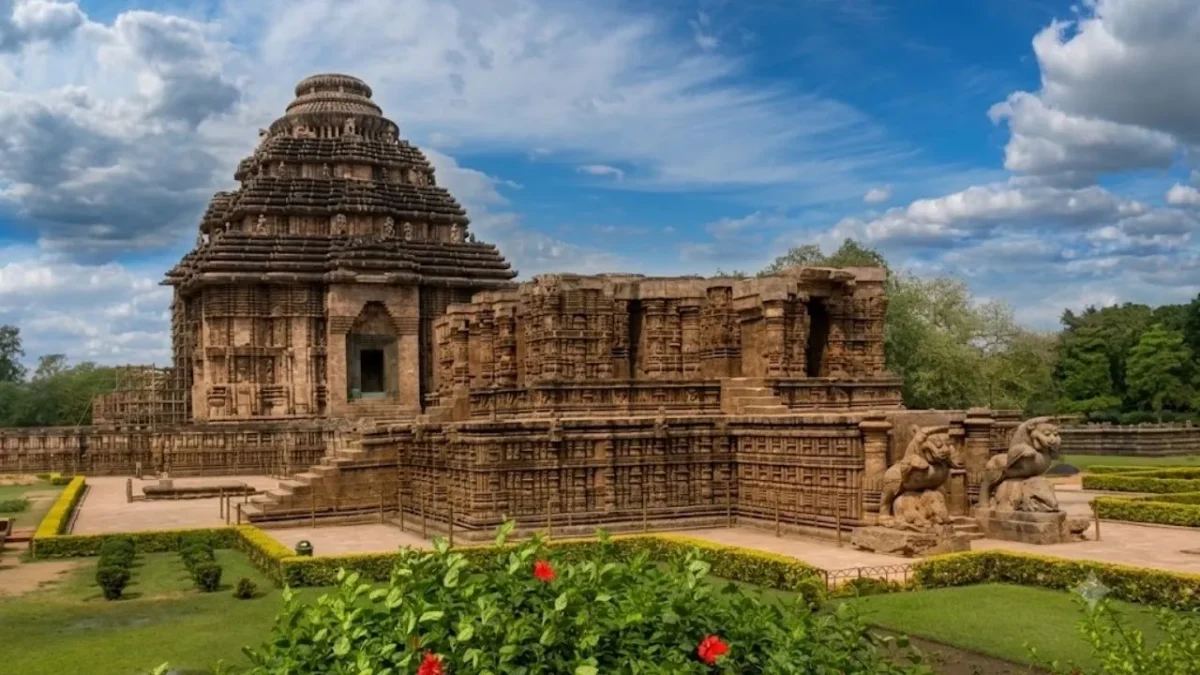

Summary: The Konark Sun Temple is in the coastal village of Konark in Odisha, India. It was built around 1250 CE by an Eastern Ganga king named Narasimhadeva I. The temple was designed to look like a giant stone chariot carrying the sun god Surya across the sky. It once had a tall tower and a lower hall, surrounded by 24 carved stone wheels and a team of horses. The tower fell down at some point in history, and nobody knows exactly why. Today, the surviving hall is still impressive enough that the temple became a UNESCO World Heritage Site in 1984.
Table of Contents
A Wheel That Tells Time, on a Konark Temple That Fell Silent
Walk around the base of the Konark Sun Temple today, and you will find one of its 24 stone wheels right at eye level. It is about three metres wide. Its rim is carved with small beads, and its spokes divide the wheel into eight parts. Local guides often explain how the shadow of the centre pole once let people read the time of day, almost like a giant sundial. Whether the wheel really worked with scientific accuracy is a claim you will hear a lot from tour guides and travel blogs, but it is not something that has been carefully proven by engineers or archaeologists. So this article treats it as a wonderful piece of temple storytelling, not a confirmed scientific fact.
One thing is certain, though. Someone in 13th century Odisha decided that a temple to the sun god should not just show his chariot in a carving on a wall, the way older temples did. It should become the chariot itself, wheels, horses and all, built on a scale that still amazes visitors more than 700 years later.
This article walks through what is well proven about Konark, what historians still argue about, and what survives only as legend. A temple this famous has collected plenty of all three.
Where and When: Building Konark Temple on the Bay of Bengal
The temple stands in Konark, a small town on the coast of the Bay of Bengal in the Indian state of Odisha. It is about 35 km northeast of the city of Puri, and about 65 km southeast of the state capital, Bhubaneswar. It was originally built near the mouth of the Chandrabhaga river, but the coastline has moved back over the centuries, so the temple now sits a little further from the sea than it once did.
Most reliable sources say the temple was built around 1250 CE, during the rule of the Eastern Ganga king Narasimhadeva I (who ruled from 1238 to 1264 CE). A few sources place its completion a little later, in the mid-1250s. This small gap of a few years is normal for old Indian monuments, since no single stone inscription giving the exact completion date has survived. The safest way to state it is “around 1250 CE,” not a fixed year.
Evidence status: The Archaeological Survey of India (ASI), UNESCO, and India’s Ministry of Culture all agree on the mid-13th-century date and on Narasimhadeva I as the builder, even though the exact year is not fixed by one single record.
Who Built Konark Temple and Why
Narasimhadeva I belonged to the Eastern Ganga dynasty. This royal family had already built the Jagannath Temple at Puri about a century earlier, and it went on to shape much of Odisha’s temple architecture for another 200 years. Some sources say the Sun Temple was built to celebrate a military victory, but different sources describe different battles, so this detail should be read as a likely reason, not a fully proven one.
The temple was dedicated to Surya, the sun god. Worship of the sun has a long history across India, and scholars generally agree that it spread to Odisha from earlier centres of sun worship further north and west. Konark is often called the high point of Kalinga temple architecture. Kalinga is the old name for the region that is now roughly coastal Odisha.
Evidence status: For the dynasty and the dedication to Surya.
Reading the Chariot: Architecture and Symbolism
The builders worked in the Kalinga style of temple architecture. This is the same style seen at the Lingaraja Temple in Bhubaneswar and the Jagannath Temple in Puri. Two parts of the building matter most:
- The rekha deul (sanctum tower): This tall, curved tower once held the main shrine. Different sources give slightly different height estimates, from about 200 to 229 feet (roughly 61 to 70 metres). It no longer stands today (more on that below).
- The jagamohana (assembly hall): This pyramid-shaped hall is about 128 feet (39 metres) tall. It has mostly survived, and it is the part of the temple that most visitors actually see and photograph.
The complex also included a nata mandira (dance hall) and a bhoga mandapa (hall for food offerings). Both are now partly ruined.
The whole complex is carved to look like Surya’s chariot:
- 24 wheels, arranged in two rows of twelve along the base. Each wheel is about three metres wide and carved with detailed spokes and patterns. Some sources say the 24 wheels stand for the 24 hours of the day. Other sources say they stand for the 12 months, counted twice for the two rows. Both explanations appear in trustworthy sources, so this article presents both instead of picking one as the “real” answer.
- A team of horses pulling the chariot. Old texts and ASI records describe seven horses, matching the seven days of the week. But only some of these horses have survived in good condition today, and sources do not fully agree on the exact number still standing. This may explain why a few newer summaries, including one from UNESCO, mention six horses instead of seven. The mix-up likely comes from confusing the original design with what survives now.
- Two guardian lions at the eastern entrance, each shown standing on top of a war elephant, which is itself shown on top of a human figure. Many guides explain this as a symbol of pride, wealth, and human weakness, but this exact meaning is an interpretation, not something the original builders wrote down.
The temple walls are covered in detailed carvings of gods, musicians, dancers, animals, and scenes of daily and royal life. The stone used is mostly khondalite, a local rock. Iron beams were reportedly used to help support parts of the structure. The temple faces east, so that the first light of the rising sun would once have hit the main entrance.
Evidence status: For the chariot design, the 24 wheel base, and the surviving jagamohana and its size. (WELL-SUPPORTED but not fully settled) for the exact original number of horses and for whether the wheels stand for hours or months. Present both explanations rather than choosing one.
The Legend of Dharmapada
No story about Konark is complete without the tale of a building crisis during construction, and no honest article leaves out that this is a legend, not a proven historical event.
According to the story, which is even recorded in UNESCO’s own background documents as a legend, the temple’s architect was named Bisu Maharana (sometimes spelled Bishu Moharana). He left home to focus on the project, and during his long absence, he became a father. His son, Dharmapada, later travelled to Konark, joined the workshop, and is said to have finished a difficult part of the building that his father could not complete. In the most common version of the story, Dharmapada then sacrificed himself, in some tellings by jumping into the sea, to protect the workers from the king’s anger over the delay.
Traditional account note: This is a traditional or legendary story, kept alive through local memory and repeated in UNESCO’s own descriptions of the site. It matters a great deal to how people remember Konark, but this article does not treat it as proven history.
Why the Temple Fell: A Mystery Even Historians Debate
This is the part of Konark’s story where it would be easy to give a neat, simple answer. But there isn’t one, and a careful article should say so clearly.
At some point, the temple’s main tower collapsed, leaving only the jagamohana standing as the main ruin we see today. Visitors in the 1860s and 1870s left written accounts describing the site already in ruins. Some later, popular sources give a specific year for the final collapse, 1837, but the ASI’s own writing about the site’s history is honest that the exact cause and timing are still not settled. The ASI lists several competing ideas side by side:
- A natural disaster, such as lightning or an earthquake.
- The tower’s own huge weight causing it to sink and fail on the soft, sandy ground near the coast. This idea is linked to the 19th-century architecture historian James Fergusson.
- Deliberate damage, in one theory linked to a 16th-century military commander named Kalapahar, who some historical accounts also connect to an attack on the Jagannath Temple at Puri in 1568.
The ASI itself points out that this is puzzling, because similar large Kalinga temples at Bhubaneswar and Puri have survived without this kind of major structural collapse. That is a big part of why no single explanation has become the accepted answer among historians.
A related and equally unsettled question is what happened to the temple’s main statue of Surya. Different sources say it was moved to the Jagannath Temple at Puri for safekeeping at some point between the 1400s and 1600s, during a time of military threats. But sources disagree on the exact date, the ruler responsible, and the details of what happened. No single version of this story should be treated as settled fact.
Dispute note: Sources differ on this point. It is well established that the tower no longer stands and the jagamohana does survive. But the exact cause and date of the tower’s fall, and the fate of the original statue, are genuinely debated by historians and archaeologists. Readers should not treat any one theory as the final answer.
From Ruin to Restoration of Konark Temple: The ASI’s Role
By the 1800s, Konark had fallen into serious disrepair. Some of its carved stones were moved to other places, including the Jagannath Temple complex at Puri. Serious repair and protection work began in the early 1900s. In one important step, workers filled the surviving jagamohana with sand in the early 1900s to help stop it from collapsing further. Because of this, visitors today cannot go inside the hall’s inner chamber.
The Archaeological Survey of India has looked after the site since the late 1930s. Its ongoing work deals with salt damage, water seeping into the stone, and plant growth, the same coastal conditions that may have caused the original collapse. A museum run by the ASI displays sculptures and stone pieces found during cleanup work around the site. The temple joined the UNESCO World Heritage List in 1984. UNESCO’s reasons include its bold design as a sun god’s chariot, its rich storytelling carvings, and its living connection to Hindu religious and ritual traditions.
Evidence status: For ASI’s care of the site, the sand filling of the jagamohana, the museum, and the 1984 UNESCO listing and its stated reasons.
What Is Confirmed, Debated, and Traditional
Confirmed:
- Built in the mid 1200s under the Eastern Ganga king Narasimhadeva I.
- Designed as a giant stone chariot for Surya, with a base of 24 wheels.
- The jagamohana (assembly hall) still stands. The original tower does not.
- Became a UNESCO World Heritage Site in 1984, and is cared for by the ASI.
Debated:
- The exact year construction finished (sources range across the early to mid 1250s).
- The exact cause and date of the tower’s collapse.
- The exact original number of horses compared with how many survive today.
- The date, ruler, and details behind the removal of the temple’s main statue.
Traditional or legendary:
- The story of the architect Bisu Maharana and his son Dharmapada.
- The popular claim that the wheels worked as precise, accurate sundials. This is repeated often but not backed by careful engineering study.
Visiting the Konark Sun Temple
Current information note: Prices, hours, and show times can change. The details below come from recent (2026) travel reports, not from a single official page checked live at the time of writing. Please confirm exact current details on the ASI e-ticketing website or with Odisha Tourism before you travel.
- Location: Konark, Odisha. About 35 km from Puri and 65 km from Bhubaneswar.
- Hours: Several recent sources say the site is open every day, roughly from 6:00 AM to 8:00 PM, with no weekly closing day.
- Entry fee: Recent (2026) sources most often mention ₹40 for Indian, SAARC, and BIMSTEC visitors, and about ₹600 for foreign visitors. Children under five usually enter free. Older and lower prices also appear online, so treat this as an estimate to double-check, not a fixed number.
- Light and Sound Show: A separate evening show, about 40 minutes long, usually held twice each night. Reported times are around 6:30 PM and 7:30 PM in winter, and later in the evening during the rest of the year. This show costs an extra ticket.
- Getting there: Buses and taxis run from Puri. Taxis are also available from the airport in Bhubaneswar.
- Accessibility: Garden paths are paved and flat, but the old stone areas near the temple base are uneven, with no ramps to reach higher sections.
- Nearby: The ASI’s Konark museum and Chandrabhaga Beach, which is linked to the Magha Saptami bathing festival for Surya.
Approximation note: All fees and timings above are estimates based on current travel sources. Please confirm them on the ASI e-ticketing website or Odisha Tourism’s official channels before planning your trip.
Read More: 12 Jyotirlingas in India: Names, Locations, History and Travel Guide
Living Heritage: Festival and Ritual Around Konark
Large-scale worship no longer happens inside the ruined sanctum, but Konark still connects to living traditions in two clear ways. The Konark Dance Festival, run by Odisha’s tourism department, brings classical dancers, often performing Odissi, a dance style closely tied to Odisha’s temple history, to a stage set in front of the temple. It usually runs for a few days each winter. Separately, Chandrabhaga Beach near the temple draws pilgrims for ritual bathing on Magha Saptami, a festival connected to Surya’s traditional birthday.
Evidence status: For both practices. Exact festival dates change every year, so check Odisha Tourism’s current calendar instead of relying on memory.
Key Takeaways
The Konark Sun Temple was built in the mid 1200s under the Eastern Ganga king Narasimhadeva I. It was designed as a giant stone chariot for the sun god Surya. Today, mainly the jagamohana, or assembly hall, survives, because the original tower fell down at a time and for a reason that historians still argue about. The temple’s fame rests on things that are well proven, like its huge scale, its 24-wheel chariot design, its detailed carvings, and its UNESCO World Heritage status since 1984. It also carries real legend, especially the story of Dharmapada, which this article treats as tradition, not history. A visit rewards patience. The ruins are worth exploring slowly, and it is worth double-checking prices and show times close to your travel date.
Frequently Asked Questions
Who built the Konark Sun Temple, and when?
Konark Sun Temple was built around 1250 CE, with some sources saying it finished slightly later in the 1250s, under the Eastern Ganga king Narasimhadeva I.
How many wheels and horses does the temple chariot have?
The base has 24 carved wheels. Old texts describe seven horses, though not all of the originally carved horses have survived in good condition today.
1
4