
Summary
When we hear the word atom, we usually think of modern physics, laboratories, microscopes, and scientists of the last few centuries. It often feels like atomic theory belongs entirely to the modern world. Yet, ancient Indian texts speak of ideas that sound surprisingly similar to atomic concepts. Words like anu and paramanu appear in philosophical discussions that describe matter as being made of extremely small, indivisible units. This article explores whether ancient Bharat knew about atoms, how atomic ideas appear in Vedic and later Indian thought, and what Vedic science really meant by anu and paramanu. Written in a friendly and thoughtful tone, this article separates symbolic philosophy from scientific interpretation while appreciating the depth of ancient Indian thinking.
Table of Contents
Why the Idea of Atomic Theory in Ancient India Sounds Surprising
For most of us, atomic theory begins with modern science textbooks. We learn about Dalton, Rutherford, Bohr, and quantum mechanics. Because of this, it feels surprising when someone claims that ancient Bharat knew about atoms. The surprise comes from how we imagine ancient societies. We imagine them as spiritual but not scientific. We imagine rituals, prayers, and myths, not careful thinking about matter. But ancient Indian thinkers were not only spiritual seekers. They were also sharp observers of nature. They asked deep questions about reality, matter, time, space, and change. Their methods were different from modern science, but their curiosity was just as strong.
What Vedic Science Really Means
Before going further, it is important to clarify one thing. When we say Vedic science, we are not talking about science in the modern laboratory sense. Ancient Indian thinkers did not use microscopes or particle accelerators.
Vedic science was philosophical and observational.
It asked questions like:
What is the world made of
What is permanent and what changes
What is the smallest unit of existence
How does form arise from the formless
These questions led to deep ideas about matter and reality.
The Meaning of Anu and Paramanu
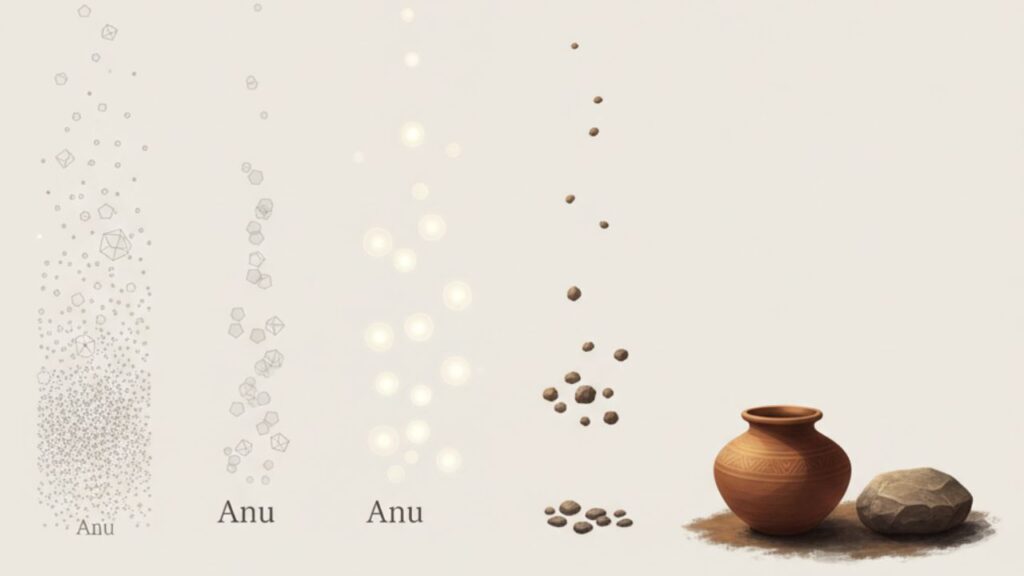
The most important terms in discussions of atomic theory ancient India are anu and paramanu. In Sanskrit, anu means something extremely small. It can mean minute, subtle, or fine. Paramanu literally means the smallest possible anu. It refers to the smallest indivisible unit of matter. Ancient Indian thinkers described paramanu as something that could not be broken down further. It was beyond perception. It had no parts. This already sounds very close to the basic idea of an atom.
Early Mentions in Vedic and Philosophical Texts
The earliest Vedic hymns are mostly poetic and symbolic. They focus on cosmic order, nature, and existence. They do not describe atomic theory directly. However, later Vedic and post Vedic philosophical texts go deeper into the nature of matter.
These texts begin asking:
If everything changes, what remains constant
If objects break down, what is the smallest unit
If form disappears, what remains
From these questions emerged the concept of anu and paramanu.
The Vaisheshika School and Atomic Thought
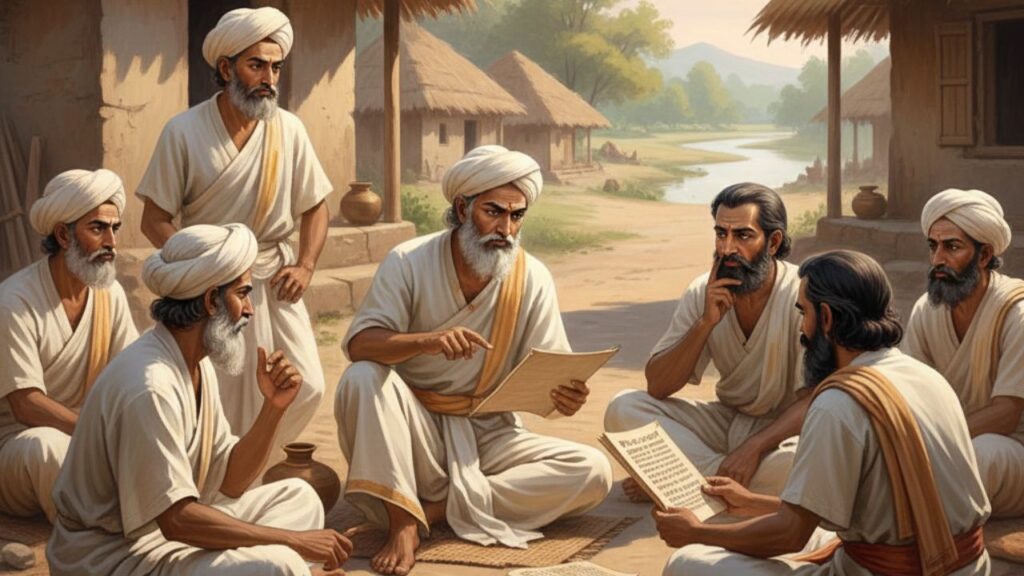
One of the clearest expressions of atomic theory ancient India comes from the Vaisheshika school of philosophy. This school developed a detailed theory of matter.
According to Vaisheshika thinkers:
- All physical matter is made of paramanus
- Paramanu is indivisible and eternal
- Paramanu combines with other paramanus to form visible matter
- Different combinations create different substances
They identified different types of paramanus corresponding to elements like earth, water, fire, and air. This system was not poetic metaphor alone. It was logical and structured.
How Ancient Thinkers Imagined Atomic Combination
Ancient Indian philosophers described how paramanus combine.
They believed:
- Two paramanus form a dyad
- Three dyads form a triad
- Larger structures arise from further combinations
Matter became visible only when enough paramanus came together. This is remarkably similar to the modern idea that atoms combine to form molecules, which then form visible matter. The language is different, but the intuition is striking.
Atomic Ideas Were Philosophical, Not Experimental
It is important to remain honest and balanced. Ancient Indian atomic theory was philosophical. It was not based on experimental measurement. There were no experiments to observe atoms. Instead, thinkers used logic and reasoning.
They reasoned that:
- Objects can be divided
- Division cannot continue infinitely
- Therefore a smallest unit must exist
This reasoning appears in many philosophical traditions around the world. What makes ancient Bharat special is how clearly and systematically this idea was developed.
Anu and Paramanu Beyond Physical Matter
One fascinating aspect of Vedic science is that atomic ideas were not limited to physical matter.
Ancient texts also speak of:
- Subtle elements
- Mental processes
- Time as composed of moments
- Space as composed of subtle points
Just as matter had paramanus, time had instants, and thought had subtle movements. This shows that atomic thinking was part of a broader worldview.
Time and Atomic Moments
Some ancient Indian texts describe time as being composed of extremely small units. Just as matter was divided into paramanus, time was divided into moments. This idea suggests that ancient thinkers were trying to understand reality at its most fundamental level. They saw the universe as structured, not random.
Comparison With Greek Atomic Thought
Ancient India was not alone in developing atomic ideas. Greek thinkers like Democritus also spoke of atoms. However, there are key differences. Greek atomic theory focused mainly on physical matter. Indian atomic theory included matter, mind, time, and causation. It was embedded in a larger philosophical system that connected physics with metaphysics.
Did Ancient Bharat Know Atoms Like Modern Science
This is the most important question. Did ancient Bharat know atoms in the modern scientific sense The honest answer is no. Ancient Indian thinkers did not know about electrons, protons, neutrons, or nuclear forces. They did not perform experiments or develop mathematical models like modern physics. But did they develop an abstract idea of indivisible units of matter
Yes.
And they did so with impressive clarity.
Why This Does Not Reduce Their Achievement
Some people feel disappointed when they hear that ancient atomic theory was not modern science. But this disappointment is unnecessary. Ancient thinkers worked with the tools they had. They used observation, logic, and deep contemplation. Within those limits, their insights were remarkable. They anticipated questions that modern science would take centuries to explore.
Separating Pride From Proof
It is natural to feel pride in ancient Indian knowledge. But pride should not lead to exaggeration. We do not need to claim that ancient Indians had nuclear reactors or particle physics. The truth itself is powerful. Ancient Bharat produced thinkers who reasoned deeply about reality. They developed abstract atomic concepts long before microscopes existed. That alone deserves respect.
Why Atomic Theory Matters in Indian Philosophy
Atomic theory ancient India was not about technology. It was about understanding reality. It helped answer questions like:
Why things change
Why objects have form
Why destruction does not mean non existence
Why creation is a process, not a miracle
These ideas influenced Indian metaphysics, logic, and cosmology.
Anu and Paramanu in Everyday Language
Even today, words like anu remain in Indian languages. They are used to describe smallness, subtlety, and minuteness. This shows how deeply these ideas entered cultural thinking. They were not confined to elite philosophy.
Vedic Science and Modern Curiosity
Modern scientists sometimes look at ancient ideas with curiosity. Not because ancient texts were scientifically correct in every detail. But because they show how human curiosity works across time. Different cultures asked similar questions and reached surprisingly similar intuitions.
Why This Topic Is Often Misused Today
Unfortunately, atomic theory in ancient India is sometimes misused. Some people exaggerate claims to prove superiority. Others dismiss everything as myth. Both extremes miss the point. Ancient Indian atomic thought deserves calm, respectful study.
A Balanced Way to Understand Ancient Atomic Ideas
The best way to understand atomic theory ancient India is to hold two ideas together. Ancient thinkers were not modern scientists. Ancient thinkers were deep and original philosophers. When we respect both, we honor history properly.
Key Takeaways
- Ancient Indian texts speak of anu and paramanu as the smallest units of matter
- Atomic theory ancient India developed mainly through philosophical reasoning
- The Vaisheshika school presented a detailed atomic framework
- Paramanu was considered indivisible and eternal
- Matter was formed through combinations of paramanus
- Atomic ideas extended beyond matter to time and mind
- Ancient atomic theory was not experimental science
- It still shows remarkable intellectual depth
- Vedic science combined observation, logic, and metaphysics
- Understanding these ideas requires balance, not exaggeration
Citations
- Encyclopedia Britannica. Vaisheshika Philosophy and Atomic Theory
- Indian Philosophy Texts on Anu and Paramanu
- Oxford Handbook of Indian Philosophy
- History of Science in Ancient India. National Council of Educational Research
- Journal of Indian Philosophy. Studies on Atomic Concepts
- Radhakrishnan. Indian Philosophy
- World History Encyclopedia. Early Atomic Theories