
Summary
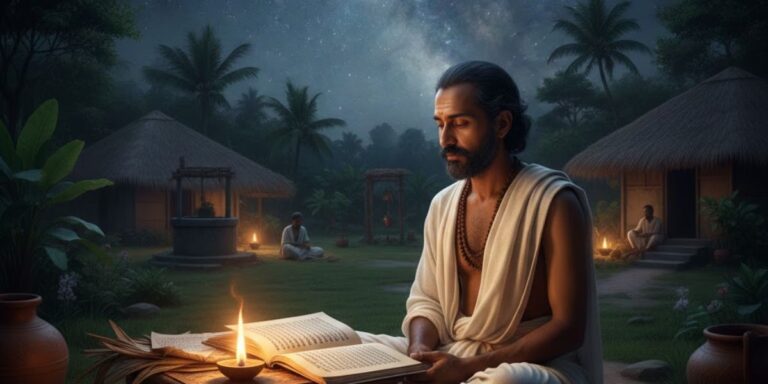
C.V. Raman’s deep curiosity about nature led to a groundbreaking discovery that changed the study of light. By observing rivers, seas, and the blue sky, he uncovered the Raman Effect, earning the Nobel Prize in Physics in 1930 at just 42. His work transformed modern science and advanced spectroscopy worldwide. Raman’s life of discipline and careful observation proved that world-class scientific research could be achieved entirely in India.
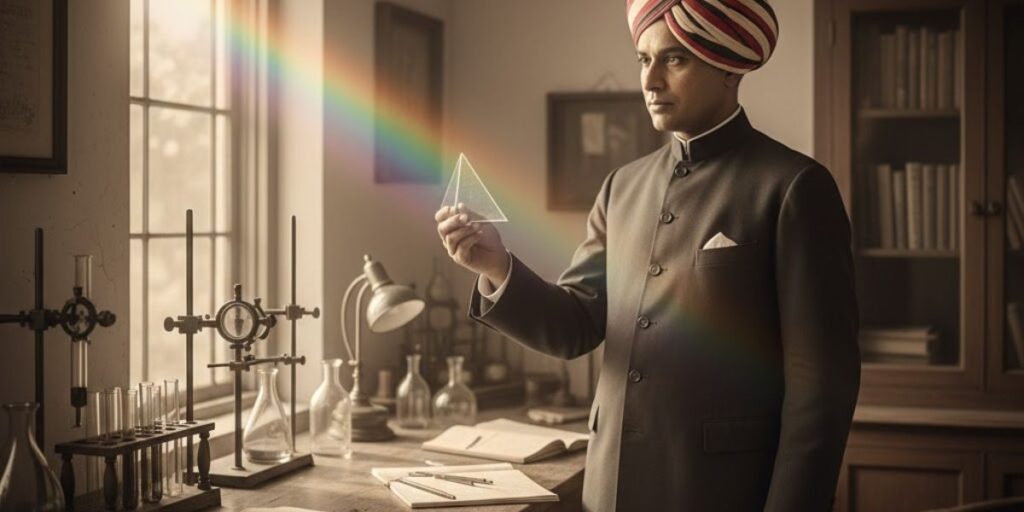
Table of Contents
C.V. Raman’s Early Life and Family Background
Chandrasekhara Venkata Raman, known as C.V. Raman, was born on 7 November 1888 in Tiruchirappalli, in the Madras Presidency. His father, R. Chandrasekhara Iyer, taught physics and mathematics. His family valued education, discipline, and learning. They were not wealthy, but knowledge was always encouraged.
Raman later said he was “born with a copper spoon.” By this, he meant that he grew up in a home that supported learning. From childhood, he showed strong curiosity. He watched the sunlight, studied the colors of water, and listened carefully to sounds from musical instruments.
He completed secondary school at the age of eleven. In 1901, when he was thirteen, he joined Presidency College in Madras. By the age of eighteen, he had completed his master’s degree in physics. During his college years, he published his first research paper in Philosophical Magazine. This was the first international research paper from his college.
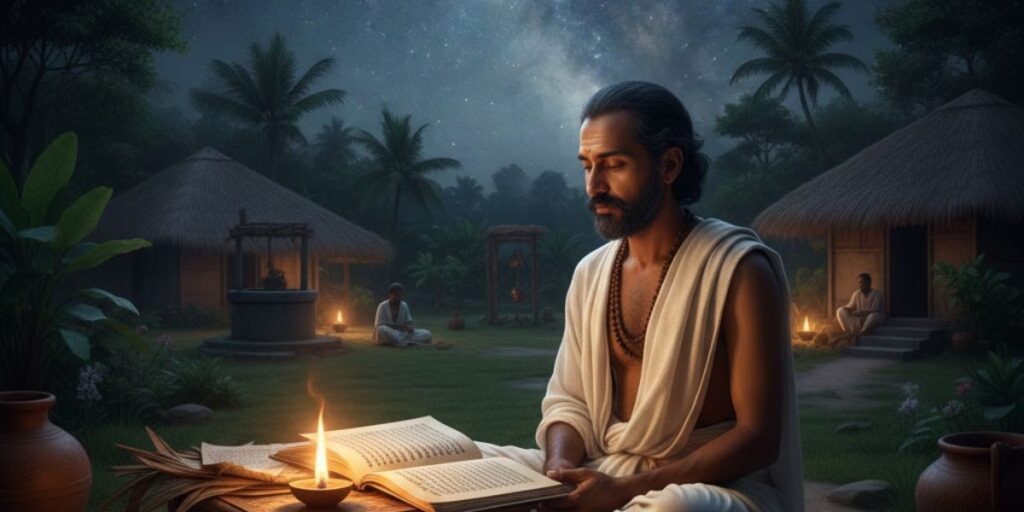
Raman also loved music, literature, and philosophy. These interests stayed with him throughout his life. They shaped the way he looked at science. He believed science was closely connected to life, culture, and nature.
C.V. Raman’s First Steps in Science

After finishing his studies, Raman joined the Indian Finance Service in 1907. He worked as Assistant Accountant General in Calcutta. The job gave him financial security. However, it did not give him time or space for research. Even then, Raman did not stop experimenting. He carried out small experiments at home and in laboratories during his free time. He used simple tools and relied on careful observation.
In 1917, Raman made an important decision. He left his government job and joined the University of Calcutta as the first Palit Professor of Physics. His salary was lower, but he gained freedom to do research. At the Rajabazar Science College, he worked with limited equipment. Still, his results were accurate and meaningful.
Raman encouraged students to learn by observing nature. He believed that patience and curiosity were essential for science. During this period, he studied sound and vibrations in musical instruments. His work explained how Indian instruments produced their special tones. This research linked science with Indian cultural traditions.
C.V. Raman’s Inspiration: The Blue Sea and the Sky
In 1921, Raman traveled to Oxford for academic work. While returning to India on the ship SS Narkunda, he began thinking about a simple question. Why does the sea appear blue?
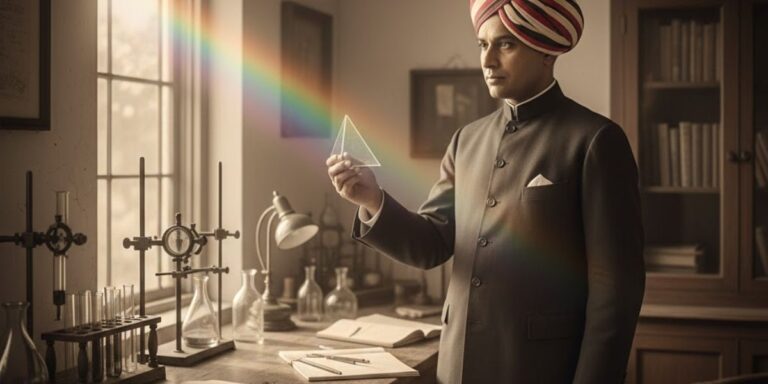
At that time, many scientists believed the sea reflected the blue sky. Raman tested this idea using a prism to remove reflected light. Even after removing reflection, the water remained blue. This showed that the color came from the water itself.
This observation changed the direction of his research. A simple question during a sea journey led him to study light more deeply. Raman showed that great discoveries can begin with close attention to everyday sights.
C.V. Raman’s Discovery of the Raman Effect
In 1928, Raman and his research team studied how light behaves when it passes through transparent materials. They noticed something unusual. A small part of the light changed its wavelength after passing through the material.
This effect later became known as the Raman Effect. It showed that light interacts with molecules in a special way. This discovery allowed scientists to study the structure of matter using light.
Raman used simple instruments for his experiments. He repeated them many times to confirm the results. His careful method gave confidence in his findings.
In 1930, Raman received the Nobel Prize in Physics. He was the first Asian and non-white scientist to receive this honor. He also remains the only Nobel laureate in science of Indian origin who studied, worked, and lived in India throughout his life. Even after international recognition, he chose to stay in India and serve its scientific community.
C.V. Raman Explains Why the Sky Is Blue
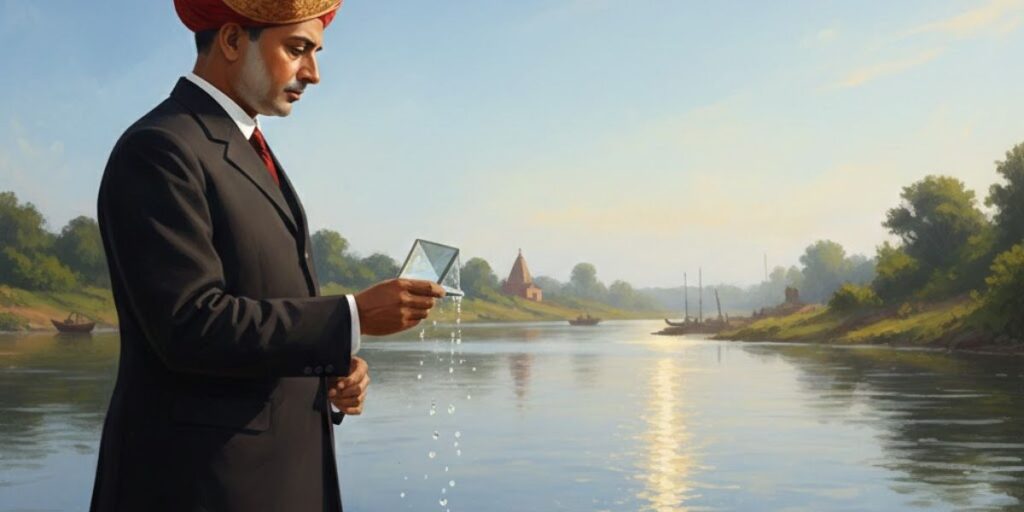
Raman also studied the color of the sky. He showed that air molecules scatter short wavelengths of light, such as blue, more than longer wavelengths like red.
Because of this scattering, blue light spreads in all directions. This makes the sky appear blue to our eyes.
Raman explained this using simple experiments and clear logic. He believed science should be easy to understand. His work corrected earlier ideas and strengthened the study of light.
C.V. Raman’s Contributions Beyond Light
Raman’s work extended beyond the study of light.
Acoustics and Music:
Between 1910 and 1915, Raman studied sound in musical instruments. He explained how vibration and resonance create musical notes. His research helped explain the unique sound of Indian classical instruments such as the veena.
Optics and Spectroscopy:
His work on light scattering became the basis for modern spectroscopy. This method is now used to study materials at the molecular level.
Building Scientific Institutions:
Raman played a major role in developing science in India. He served as the first Indian director of the Indian Institute of Science. He founded the Indian Academy of Sciences and established the Raman Research Institute.
Mentorship:
As a teacher, Raman encouraged independent thinking. He asked students to observe carefully and think deeply. He believed true learning comes from curiosity and practice.
C.V. Raman’s Recognition and Character
Raman’s discoveries earned worldwide respect. Still, he chose to live and work in India. He followed a simple and disciplined lifestyle. He valued honesty, focus, and hard work.
He had a strong interest in music, literature, and nature. These interests gave balance to his scientific life. Students admired his clarity and dedication. Despite his fame, he remained humble and approachable.
C.V. Raman’s Later Life and Legacy
In his later years, Raman continued guiding research at his institute. In October 1970, he suffered a cardiac arrest. Even then, he chose to stay among students and colleagues at the Raman Research Institute.
He passed away on 21 November 1970 at the age of eighty-two. Prime Minister Indira Gandhi called him India’s greatest scientist. His work continues to influence science education and research in the country.
Cultural Significance
A Symbol of National Pride
C.V. Raman remains a symbol of national pride. His Nobel Prize in 1930 showed that advanced scientific research was possible in India, even during colonial rule. February 28, the day he discovered the Raman Effect, is celebrated as National Science Day in India.
Integration of Science and Tradition
Raman connected scientific study with Indian tradition. His work on music and natural colors showed that science can grow from cultural roots.
Institutional and Practical Legacy
The Raman Effect is used worldwide today. It helps doctors detect diseases, scientists study chemicals, and experts examine artworks. It allows testing without damaging materials.
Observational Method and Influence
Raman taught that careful observation is the heart of science. His approach continues to guide students and teachers across India.
Key Takeaways
- Raman turned simple observations into great discoveries.
- He showed that top-level science could be done in India.
- The Raman Effect is important in many scientific fields.
- Discipline and patience shaped his work.
- His life continues to inspire scientific thinking.
Citations
- Krishnan, K. (1970). C.V. Raman: His Life and Work. Indian Academy of Sciences.
- Raman, C.V. (1928). The Scattering of Light and the Raman Effect. Proceedings of the Indian Academy of Sciences.
- Government of India. (2020). National Science Day – C.V. Raman. Ministry of Science and Technology. Wikipedia contributors. (2024).C. V. Raman. Wikipedia, The Free Encyclopedia.
Read More About Indian Legend
Dadasaheb Phalke’s Raja Harishchandra: Father of Indian Cinema’s First Reel