

Summary
Aryabhata was a 5th-century Indian scholar who explained the sky through mathematics. In his book, the Aryabhatiya, he described Earth’s rotation, gave clear reasons for eclipses, and calculated the movements of the Moon and planets with striking accuracy. Centuries later, scholars of the Kerala School of Astronomy and Mathematics refined his methods, building precise lunar and planetary models through careful observation and steady calculation.
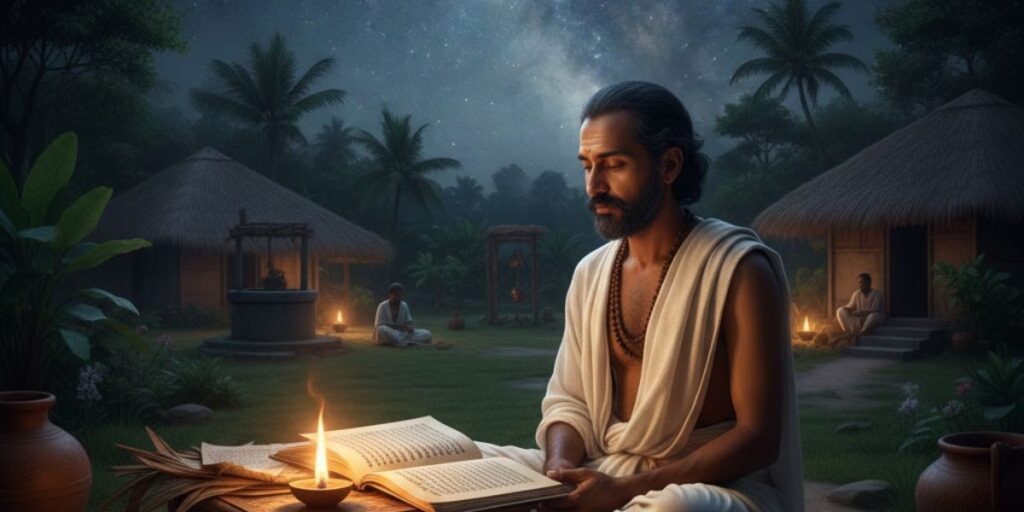
Table of Contents
When the Sky Was the Only Guide
Long before observatories existed, the sky was the only teacher people had.
They learned by watching. The Moon changed shape from night to night. It rose in slightly different positions along the horizon from one week to the next. Some nights it moved faster across the sky. Other nights it moved more slowly. None of it felt random, but none of it was easy to explain either.
Slowly, over many generations, observers began to find order behind the movement. The same patterns repeated. The same cycles returned. And with that growing sense of order came questions that needed real answers.
Why does the Moon change shape? Why does it always return to the same form? Why do eclipses happen, and can they be predicted?
In the 5th century CE, one scholar set out to answer those questions not with stories but with mathematics. His name was Aryabhata.
Aryabhata: A Young Scholar in a Thinking Age
Aryabhata was born in 476 CE, during India’s Gupta period, a time when learning was genuinely valued, and scholars devoted their lives to study. Cities were full of intellectual energy. Great minds were finding each other and building on each other’s work. It was the kind of age that draws out remarkable thinkers, not by accident, but because the conditions exist for them to grow.
Where exactly Aryabhata came from is still debated. Some historians place him in Kusumapura, the city now known as Patna in Bihar. Others point to the Ashmaka region in present-day Maharashtra. What nobody disputes is where his thinking eventually led him.
His personal life is largely lost to history, as it is for many ancient scholars. What survives is his work, and it speaks clearly enough.
At twenty-three, he completed the Aryabhatiya. It was just 108 verses in Sanskrit, short enough to memorise. But within those verses, he placed ideas that would shape Indian science for centuries and reach far beyond India’s borders.
Understanding Motion in a New Way
One of Aryabhata’s most important contributions was his explanation of why the sky appears to move each day.
The sky, he said, doesn’t actually rotate around the Earth. It’s the Earth itself that spins on its axis, and that spin is what makes the stars appear to sweep across the sky each night. To explain this, he used a simple and memorable image. A person sitting in a moving boat watches the riverbank appear to slide backwards. The bank isn’t moving. The boat is. In the same way, the stars don’t travel across the sky. We rotate beneath them.
It seems obvious today. In the 5th century, it was a bold and original idea, one that Europe would take another thousand years to reach independently.
His explanation of eclipses was equally direct. A solar eclipse occurs when the Moon passes between the Earth and the Sun and blocks the light. A lunar eclipse occurs when Earth’s shadow falls across the Moon. No demon. No divine cause. Just shadow and geometry, working the way they always do.
Saying this plainly took courage. Eclipses still frightened people, and older explanations had deep roots. Aryabhata said it anyway, and he backed every claim with numbers.
Turning the Sky into Numbers
What set Aryabhata apart was that explanation was never enough for him. He had to calculate.
He estimated the length of the solar year and came within about three minutes of the figure modern science gives us today, with no clock, no telescope, and no instrument of any kind that we would recognise. He worked out a value for pi accurate to four decimal places and noted honestly that it was only an approximation, not the exact figure. That matters. It shows he understood the difference between a working estimate and a precise truth, and he was clear about which one he had.
He built detailed tables for measuring angles in the sky, giving other astronomers a reliable tool to work with. He developed a method called Kuttaka, roughly translated as “pulveriser”, for solving problems with two unknowns at once. This kind of algebra would not appear in European mathematics for centuries. He also worked out step-by-step methods for finding square roots and cube roots that anyone could learn and apply.
Then there is perhaps his most striking calculation: the circumference of the Earth. His figure was about 39,968 kilometres. The actual measurement is 40,075 kilometres. The gap is just 107 kilometres, and he arrived at it without a single modern tool.
None of this was guesswork. It came from sustained effort, rigorous method, and a refusal to accept any answer that didn’t hold up against what the sky actually showed.
What Aryabhata Left Behind
The Aryabhatiya wasn’t written to sit on a shelf. Aryabhata wrote it to be studied, taught, and passed on, and for over a thousand years, that is exactly what happened.
Teachers read it to students. Those students grew up and passed it on to their own. Arab scholars translated it and brought its ideas into wider circulation. Later mathematicians across India questioned it, tested it, and extended it. Of the roughly twenty known commentaries ever written on the Aryabhatiya, twelve came from Kerala alone, a detail that quietly points to where the tradition would eventually reach its highest point.
Later in his life, Aryabhata is believed to have led the institution at Nalanda, one of the great centres of learning in the ancient world. He likely kept teaching and working there until the end. Brahmagupta, writing more than a century later, studied his work closely — agreeing on some things, pushing back on others. That kind of honest intellectual friction is how a tradition stays sharp and alive.
India had been observing the sky carefully since at least 1200 BCE, when the Vedanga Jyotisha was written, one of the earliest texts devoted entirely to tracking stars and keeping the calendar. By the time Aryabhata was born, that tradition was over a thousand years deep. Scholars had mapped the 27 nakshatras, the stations the Moon passes through on its monthly journey. They had tracked the five planets visible to the naked eye. They had recorded eclipses over generations and learned to predict when the next would come.
But most of that earlier work was descriptive. Scholars knew what the sky did. They had not yet built a full mathematical model to explain why it behaved that way. They could note where a planet appeared on a given night. They could not yet write a formula to say where it would be six months later.
That is what Aryabhatta changed. He moved Indian astronomy from observation to prediction, from watching and recording to understanding and calculating. It was a turning point, and the door it opened would never fully close again.
The Kerala School: Where the Tradition Reached Its Peak

Between the 14th and 16th centuries, the tradition of Aryabhata had started to reach heights that the rest of the world would take more than a century to match.
It happened not in a famous city or a well-funded institution, but in the quiet backwaters of what is now Malappuram district in Kerala. A group of scholars worked in small schools, passing knowledge carefully from teacher to student, carrying the conversation with the sky further than anyone before them had managed.
Picture a courtyard in the evening, lit by oil lamps. Palm-leaf manuscripts rest beside a teacher working through a calculation. A student traces the arc of the Moon’s path, then checks his figures against what he watched in the sky the night before. When the numbers don’t match, he doesn’t ignore the difference. He goes back to the mathematics and finds what needs fixing.
That habit, always holding calculation to account against real observation, was the defining spirit of the Kerala School. And it began with one man: Madhava of Sangamagrama.
Madhava and the Moon
Madhava, who lived around 1340 CE, was working on a problem with immediate practical stakes. Across India, life ran on the lunar calendar. Every festival, every harvest, every wedding was timed by the Moon’s position. If a calculation was even slightly wrong, the whole calendar drifted. Priests announced the wrong dates. Farmers prepared for the seasons at the wrong time. Families arrived for ceremonies that had already passed.
Madhava decided to fix this properly.
He developed a system called Chandravakyas, or “Moon sentences,” short Sanskrit phrases, each encoding the Moon’s exact position for a specific day within a repeating cycle of about 248 days. A scholar who knew these phrases could find where the Moon would be on any date, past or future, with striking accuracy.
He also calculated the Moon’s anomalistic cycle, the time it takes to travel from its closest point to Earth and return to that same point. His answer was 27 days, 13 hours, 18 minutes, and 34 seconds.
The modern measurement is 27 days, 13 hours, 18 minutes, and 33.2 seconds.
The difference is less than one second. He had no telescope and no mechanical clock — just careful naked-eye observation, the mathematical tools Aryabhatta had built, and centuries of accumulated sky records behind him.
The Chain That Carried It Forward
Madhava’s school didn’t end with him. It became a living chain of scholars, each one carrying the work a little further than the one before.
Parameshvara came next. He spent fifty-five years observing eclipses with his own eyes and comparing old planetary tables against what the sky was actually showing. When the numbers didn’t match, he revised them. His updated system, called Drigganita, brought calculated planetary positions back into agreement with real observation, exactly the kind of steady, unglamorous work that forms the backbone of reliable science.
Then came Nilakantha Somayaji, who wrote the Tantrasangraha around 1500 CE. He studied Aryabhatta closely and pushed the planetary model further than anyone before him. For Mercury and Venus, he proposed that they orbit the Sun, while the Sun itself still circles the Earth. It was not a fully heliocentric model, but a thoughtful, partially Sun-centred one built from observation and mathematics, not speculation. Copernicus published his heliocentric model in Europe in 1543. Nilakantha was writing roughly four decades before that. His equations for Mercury and Venus remained the most accurate in the world until Johannes Kepler improved them in the 17th century.
Then came Jyeshthadeva, who wrote the Yuktibhasa around 1530 CE in Malayalam rather than Sanskrit, making it unusually accessible. Historians of mathematics now recognise this text as possibly the world’s first calculus textbook. It contains proofs for infinite series and methods for calculating the circumference of a circle that are mathematically identical to what we now call integral calculus. Newton and Leibniz are credited with developing calculus in Europe in the late 1600s. Jyeshthadeva wrote the Yuktibhasa more than a century before either of them.
Of all the commentaries ever written on the Aryabhatiya, twelve out of roughly twenty came from Kerala. These scholars didn’t simply admire Aryabhata. They questioned him, tested his numbers against the sky, found where he was slightly wrong, and corrected it. That is what a true tradition of learning looks like, not blind respect, but honest engagement.
Recognised Late, But Not Lost
For a long time, none of this was known outside India.
In 1834, a British mathematician named Charles Whish published a paper noting that Kerala scholars had worked out series expansions for trigonometric functions well before Europe. Even that paper attracted little attention. It took until the 20th century for historians of mathematics to seriously study what had been happening in those small schools along the Kerala backwaters, and to grasp the full depth of what was achieved there.
There is still one question historians have raised but not answered. The Malabar Coast was a major centre of the medieval spice trade, connecting Kerala to Arabia and from there to Portugal and Spain, right at the heart of the European Renaissance. Could mathematical ideas have travelled along those same routes, alongside the pepper and cardamom? Scholars have noted the possibility. No direct evidence has been found, and the question remains open.
But it doesn’t need an answer. The achievement of the Kerala School stands entirely on its own.
Why Aryabhata Still Matters
The history of science is often told as a story that began in ancient Greece and peaked in early modern Europe, with contributions from elsewhere treated as footnotes. Aryabhata and the Kerala School are a direct challenge to that telling.
A young man in 5th-century India worked out the size of the Earth, explained eclipses through geometry, and built mathematics that would serve astronomers for generations. A scholar in 14th century Kerala built on that foundation and mapped the Moon’s orbit to within less than a second of modern precision. A line of dedicated teachers and students carried the work forward, arrived at the core ideas of calculus more than a hundred years before Newton, and produced planetary equations that stood as the world’s most accurate for decades.
None of it happened in grand institutions. None of it was funded by rulers. It lived in small schools and quiet courtyards, in manuscripts passed carefully from hand to hand, in the simple habit of checking every number against the actual sky.
In 1975, India launched its first satellite into orbit. It was named Aryabhata, a recognition that the curiosity driving modern Indian science had roots stretching back fifteen centuries.
The instruments had changed beyond recognition. The spirit hadn’t.
The Moon is still out there tonight, moving along the same path those scholars traced so patiently. And in a quiet but real way, their work is still with us.
Key Takeaways
- Aryabhatta was born in 476 CE and wrote the Aryabhatiya at 23. It became one of the most studied science texts in history, read, translated, and built upon for over a thousand years.
- He explained the Earth’s rotation and the true cause of eclipses. At a time when eclipses inspired fear, he gave a clear geometric explanation for both solar and lunar eclipses.
- His mathematical contributions were centuries ahead of their time. Trigonometry tables, the Kuttaka method, early algebra, and the place-value framework were all part of the Aryabhatiya.
- Ancient Indian astronomy had deep roots going back to 1200 BCE. Aryabhatta inherited over a thousand years of sky observation and transformed it from description into prediction.
- The Kerala School took his work to its highest point. Founded by Madhava around 1340 CE, it became a living tradition of scholars who tested, extended, and refined Aryabhatta’s ideas across generations.
- Madhava calculated the Moon’s orbit cycle to within less than one second. He did this with no instrument, only mathematics and centuries of recorded Indian sky data.
- India arrived at calculus over a century before Europe. The Yuktibhasa by Jyeshthadeva (~1530 CE) contains the foundations of integral calculus, long before Newton and Leibniz.
- Nilakantha’s partially Sun-centred planetary model was the most accurate before Kepler. His geo-heliocentric system for Mercury and Venus, written around 1500 CE, stood as the global standard for decades.
- This entire tradition survived without royal funding or grand institutions. It lived in small schools, in quiet conversations between teachers and students, and in manuscripts copied by hand.
- India’s first satellite, launched in 1975, was named Aryabhata — a tribute that connects his ancient curiosity directly to modern Indian science.
Citations & Sources
- Aryabhata — Wikipedia: en.wikipedia.org/wiki/Aryabhata
- Aryabhatiya — Wikipedia: en.wikipedia.org/wiki/Aryabhatiya
- Kerala School of Astronomy and Mathematics — Wikipedia: en.wikipedia.org/wiki/Kerala_school_of_astronomy_and_mathematics
- Madhava of Sangamagrama — Wikipedia: en.wikipedia.org/wiki/Madhava_of_Sangamagrama
- Indian Astronomy — Wikipedia: en.wikipedia.org/wiki/Indian_astronomy
- The Legacy of Sangamagrama Madhava and Kerala School — Science India Magazine: scienceindiamag.in
- Contribution of Kerala Scholars to Astronomy — Anantaa Journal, 2024: anantaajournal.com
- Kerala School of Astronomy and Mathematics — Vedic Heritage Portal, Government of India: vedicheritage.gov.in
- Kerala School of Astronomy and Mathematics — SpringerLink Reference: link.springer.com
- Mathematics and Astronomy in Ancient India — IIT Dharwad: iitdh.ac.in
Read More About Indian Legends:
C.V. Raman’s Nobel Blue: Scientist Proved Sky’s Color with River Light
Vikram Sarabhai’s Rocket Roots: Space Pioneer Who Planted Thumba’s Coconut Launchpad